
IFS slams 2026 mid-year budget, cites poor execution and unrealistic targets
News
 Dr Said Boakye, Senior Research Fellow and Acting Executive Director, IFS
The Institute for Fiscal Studies (IFS) says the implementation of the 2026 Mid-Year Budget is facing "serious challenges", hence citing poor budget execution, unrealistic revenue and GDP targets and data inconsistencies that undermine the credibility of government’s fiscal plan.
Presenting the IFS review, Senior Research Fellow and Acting Executive Director, Dr. Said Boakye acknowledged some positives but warned that the government’s failure to spend as budgeted is already hurting economic growth.
Dr. Boakye said while the macroeconomic environment was stable in H1 2026 with inflation dropping to 5.3% in June and interest rates falling significantly, the government failed to spend according to plan.
“While the government planned to spend GHS 172.5 billion including arrears payments in the first half of the year, actual expenditure fell short by as much as GHS 35.6 billion, representing 20.6% of the budgeted amount,” he stated.
He noted that capital expenditure fell short by GHS 40.35 billion (39.3%) and arrears payments by GHS 8.64 billion (61.8%).
“These two expenditure items are critical for economic growth and development. Arrears payment oils economic activities...Capital expenditure has a direct declining effect on GDP growth when it is restricted. It is no wonder that non-oil GDP growth momentum declined in Q1 2026,” he said.
Dr. Boakye blamed the shortfall largely on domestic financing which fell short by 67.2%, even as the government was simultaneously putting GHS 15.6 billion into a sinking fund not budgeted for.
“This shows poor planning on the part of the government. A budget is not something to treat casually.”
The IFS also faulted government for maintaining a total revenue and grants-to-GDP target of 16.8% and a real GDP growth target of 4.8% despite new data.
“Since 2015, revenue-to-GDP has stayed below 16%. Yet successive governments keep projecting above it. There is no justification for maintaining 16.8%,” Dr. Boakye said.
He argued the 4.8% GDP target is unrealistic because 2025 full-year growth was 6.0% and Q1 2026 growth was 6.4%.
“This development should have informed an upward adjustment. Not doing so undermines the credibility of the budget,” he added.
The IFS further identified discrepancies in the budget appendices.
According to Dr. Boakye, the total revenue target for H1 was stated as GHS 126.14 billion but the sum of the individual components amounted to GHS 125.4 billion, leaving an unexplained difference of GHS 712 million.
He also pointed out that different figures for tax refunds were used with GHS 1.59 billion used in the calculations instead of GHS 4.27 billion.
“If the bigger figure had been used, total revenue outturn would have been GHS 2.68 billion less,” he said.
Dr. Boakye further expressed concern that despite small-scale mining contributing to 51.5% of gold exports worth GHS10.8 billion in 2025, government collected zero royalties from the sector.
“Gold export increased by 103.3% but mineral royalties increased by only 21%. All royalties collected in 2025 came from large-scale. This situation should not be allowed to persist,” he added.
The IFS is, therefore, calling on government to improve budget execution and ensure financing decisions are consistent with the budget.
It also urged government to make forecasting more evidence-based and subject projections to independent review.
Additionally, the institute wants government to devise a strategy to generate revenue from the small-scale gold mining sector and to ensure consistency and reliability of fiscal data through robust validation before budget presentation.
“Ghana’s mineral resources are publicly endowed and held in trust by the state. Therefore, it is necessary that the state enjoys a fair share of the benefits,” Dr. Boakye concluded.
Source: classfmonline.com/Edem Afanou


Trending News

High Court adjourns fmr. NAFCO CEO trial to August 26 over lawyers’ illness
16:34
Concerns mount over demolition of Aayalolo Kinbu terminal for stalls
02:33
We demand immediate payment of over ¢300 million owed to mineworkers - Ghana Mineworkers’ Union calls on BoG
15:15
'Commitment is the key’ - KEEA MCE touts success of 'Nkoko Nkitinkiti' in Central Region
20:35
‘I have served with integrity’ – Afenyo-Markin defends record amid extortion claims
03:32
49 years of life, a legacy of giving: Medical Trust Fund Administrator empowers young people in Nsawam ahead of her birthday
02:26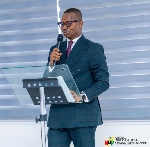
We know your ‘shady dealings’; keep mute or we’ll expose you - Eric Adjei warns Afenyo-Markin
14:43
Gas-to-power transition saves Ghana about $500m annually – Jinapor
15:02
We are public interest regulators with primary focus to protect patients - Dr. Banyubala
23:09
VALCO’s new rolling mill opens new frontiers for value-added aluminium production
15:31
